
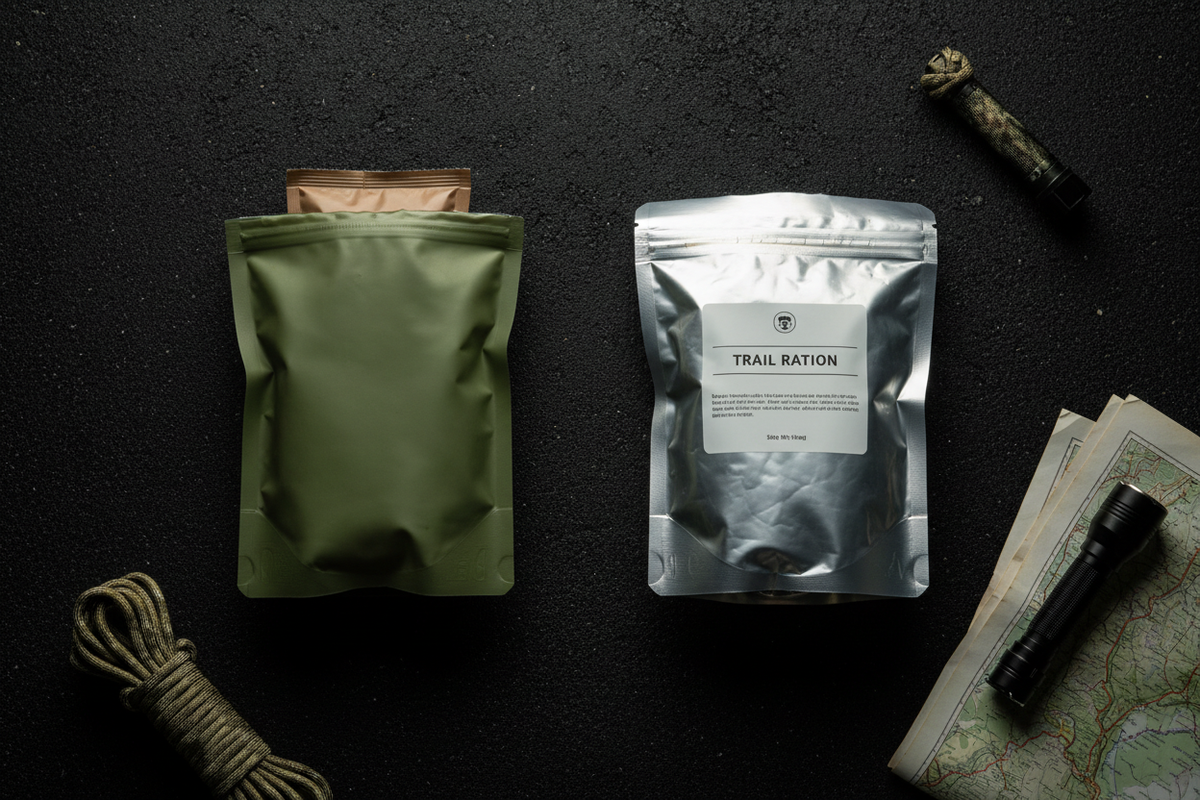

When building a long-term food storage plan or a 72-hour emergency kit, the two heavyweights of survival nutrition are MREs (Meals Ready-to-Eat) and freeze-dried food.
While both have their place in a prepper's arsenal, they are engineered for completely different scenarios. If you don't understand the science behind how they are processed and how temperature affects them, you could find yourself opening a spoiled meal when you need it most.
Here is the data-backed breakdown of MREs vs. freeze-dried food, based on Department of Defense (DoD) testing and the U.S. Army Natick Soldier Systems Center.
The Science of Shelf Life: The M.O.L.T. Rule
To understand survival food, you have to understand the enemy of preservation: M.O.L.T. — Moisture, Oxygen, Light, and Temperature.
Freeze-Dried Food: Through a process called lyophilization, foods are frozen and placed in a vacuum, causing the ice to turn directly into vapor. This removes 98% to 99% of all moisture.
MREs: These are "wet" rations. The food is fully cooked, sealed in a multi-layered foil retort pouch, and sterilized with high heat. The moisture remains entirely intact.
Because moisture is the primary catalyst for bacterial growth and food breakdown, freeze-dried food inherently has a drastically longer baseline shelf life.
MRE Shelf Life: The Temperature Factor
Because MREs still contain water, their lifespan is completely dictated by the temperature they are stored at. According to shelf-life charts established by the U.S. Army's Natick Research Laboratories, MREs do not have a traditional expiration date — instead, they operate on a sliding scale based on heat exposure:
120°F (hot car trunk): Lasts roughly 1 month.
100°F: Lasts roughly 6 months.
80°F: Lasts approximately 3 years.
75°F (standard room temperature): Lasts roughly 5 years.
60°F (cool basement): Can last 10+ years.
MREs are phenomenal for grab-and-go tactical situations, vehicle bags, and scenarios where you will not have time, fuel, or water to cook. You can eat them cold while moving. However, if you store them in a hot garage, they will spoil rapidly.
Freeze-Dried Shelf Life: The 25-Year Guarantee
Because freeze-dried foods have moisture completely stripped out and are sealed in heavy-duty Mylar with oxygen absorbers, temperature fluctuations don't degrade them nearly as fast.
When stored in a cool, dark environment (around 60°F–70°F), freeze-dried food boasts a staggering 25 to 30-year shelf life.
Freeze-dried is the gold standard for long-term emergency sheltering, basement bunkers, and bug-in scenarios. It is incredibly lightweight, making it ideal for hiking packs. The only drawback? You must have a clean water source to reconstitute it.
Which One Should You Buy?
You shouldn't choose just one — a robust preparedness plan requires both.
For your Vehicle Bag / Immediate Go-Bag: Pack MREs or calorie-dense emergency ration bars. If you are evacuating a wildfire or stranded in a snowstorm, you may not have the ability to boil water.
For your Home / Long-Term Storage: Invest heavily in freeze-dried food buckets. They offer a better return on investment over decades, taste substantially better, and are much easier on the digestive system during extended periods.
Don't wait until the shelves are empty. Check out our selection of long-term food storage and emergency rations — built for families who take preparedness seriously.
— R Prep Supply Co.