
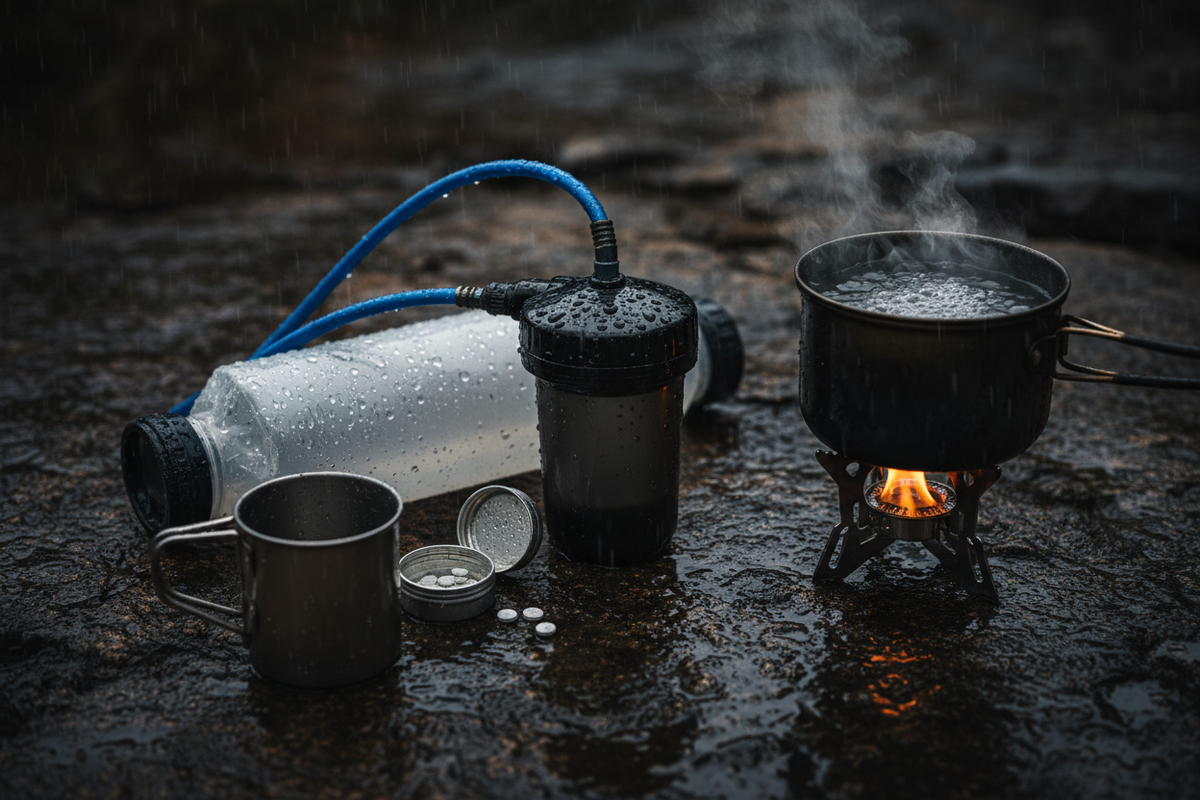

When severe flooding, hurricane surges, or pipe failures compromise municipal water systems, tap water can quickly become contaminated with deadly pathogens, bacteria, and agricultural runoff. Under boil-water advisories or total infrastructure shutdowns, securing clean drinking water becomes your highest physical priority. The Centers for Disease Control and Prevention (CDC) and the Environmental Protection Agency (EPA) lay out precise, field-tested protocols for rendering questionable water safe for human consumption.
Mechanical Filtration vs. Chemical Disinfection
Understanding the difference between filtering water and purifying water is critical for off-grid survival.
-
Water Filtration: Mechanical filters push water through microscopic pores (typically 0.1 to 0.2 microns) to strain out physical debris, microplastics, protozoa, and bacteria such as E. coli and Salmonella.
-
Water Purification: Chemical purifiers (like bleach or chlorine dioxide) use chemical agents to kill biological pathogens, specifically microscopic viruses that are small enough to pass through standard mechanical filters.
-
The Integrated Approach: Always filter cloudy water through a physical barrier before applying chemical treatment. Suspended sediment shields harmful microorganisms from chemical contact, rendering disinfection far less effective.
CDC Emergency Disinfection Protocol Using Liquid Bleach
When electrical grid failures prevent you from boiling water on an electric stove, chemical disinfection using standard household bleach is the official CDC-approved backup method.
1. Clean Water Disinfection Ratio
If your source water is completely clear:
-
Add exactly 8 drops (1/8 teaspoon) of 5% to 6% unscented liquid household bleach per gallon of water.
-
Stir the solution thoroughly and allow it to stand uncovered for at least 30 minutes.
-
The water should have a slight chlorine odor. If no chlorine odor is present after 30 minutes, repeat the dose once and let it stand for an additional 15 minutes.
2. Cloudy or Turbid Water Disinfection Ratio
If your source water is cloudy, discolored, or cold:
-
First, strain the water through a clean cloth, coffee filter, or towel to remove suspended silt.
-
Double the chemical dosage: add 16 drops (1/4 teaspoon) of 5% to 6% unscented liquid household bleach per gallon of water.
-
Stir thoroughly and let it stand for at least 30 minutes before drinking.
CRITICAL CDC WARNING: Only use standard, unscented household liquid bleach. Never use scented bleaches, color-safe formulations, non-chlorine bleaches, or bleaches with added cleaners, as these contain toxic surfactants and chemicals unfit for human consumption.
Protozoan Parasites & Tactical Water Gear
Chemical disinfectants like household bleach are highly effective against viruses and bacteria, but they take several hours to neutralize hard-shelled protozoan parasites like Cryptosporidium and Giardia.
To protect your family against all spectrums of biological contamination, combine chemical treatment with tactical micro-filters from our Water & Hydration collection. Utilizing a dual-stage setup—filtering water down to 0.1 microns and following up with chemical purification or UV treatment—guarantees safe hydration during any emergency scenario.